
A View from the Passenger Seat
I spent my childhood in the passenger seat of my mom’s car, watching the world blur by. But there’s one image that’s burned into my mind sharper than the rest: the flick.
I watched my mom flick cigarette butts out the window for years. It drove me nuts even then—the mindless disregard for the road, the wind, the habitat. Back then, I didn’t have the data. I didn’t have the words to explain why it felt like a betrayal. I just knew it was wrong.
Now, as a Conservation Strategist, I’ve realized that wasn’t just “littering.” It was a chemical strike. I’m not here to judge my mother—she didn’t know the chemistry. But I am here to help end the legacy of the “flick.” Because we are part of this puzzle, and if we poison the water for the salamander, we poison it for our children. My conviction is total: We work for the species now.
[THE RAW REALITY]: The Chemical Payload
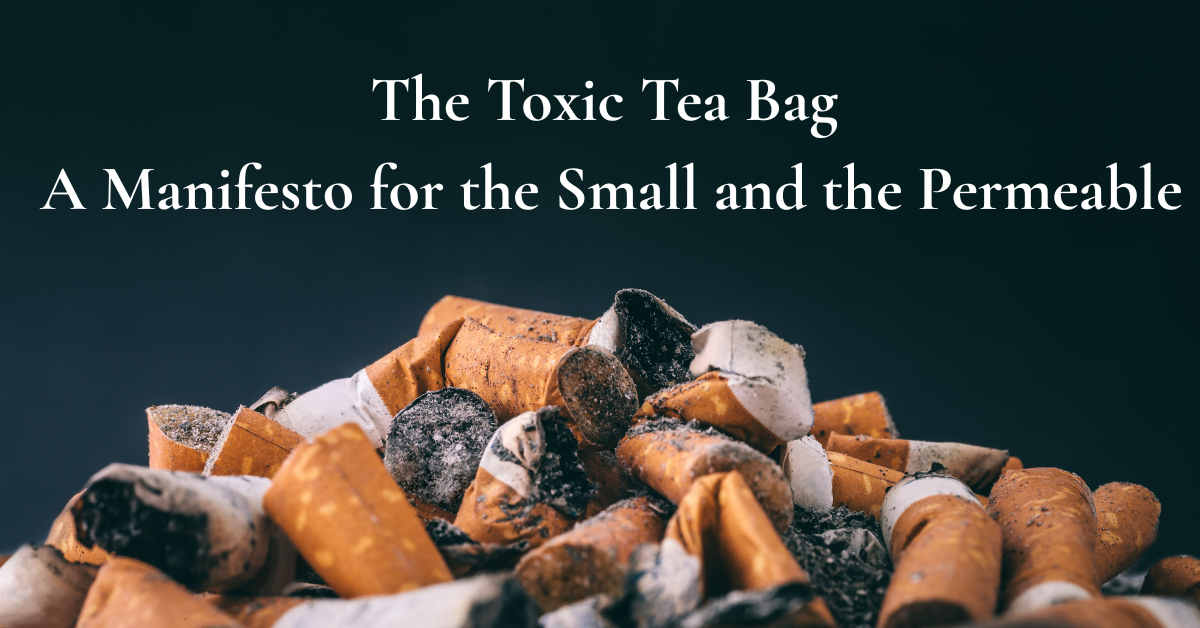
When we call it a “Toxic Tea Bag,” we are being literal. A single cigarette filter is a concentrated repository of over 7,000 chemicals, at least 250 of which are known to be toxic or carcinogenic.
As that cellulose acetate sponge steeps in our springs and soil, it releases a lethal cocktail that includes:
- Polycyclic Aromatic Hydrocarbons (PAHs): Highly persistent organic pollutants that are notoriously toxic to aquatic life and known to cause DNA damage (mutagenic).
- Cadmium: A heavy metal used in batteries that causes kidney and bone damage in vertebrates. In the “thousand cuts” of the ecosystem, this is a jagged blade.
- Benzene: A well-documented human carcinogen used as an industrial solvent. It enters the water column and infiltrates the cellular structure of everything from algae to fish.
- Chromium: Often used in stainless steel and dyes; in its hexavalent form, it is extremely toxic when absorbed through the permeable skin of amphibians.
- Ammonia: Used to increase nicotine absorption in smokers, but in a stream, it acts as a direct poison to fish, stripping the protective slime coating from their scales.
- Hydrogen Cyanide: A gas used in chemical warfare. In the micro-environment of a damp crevice, this leaches out into the moisture a salamander uses to breathe.
- Ethyl Phenol: A toxic compound that affects the taste of water and can be lethal to the microscopic invertebrates that form the foundation of the food web.
THE RAW REALITY – Mindless Ecological Sabotage
We have been too soft. We call it “littering” as if it’s an accidental spill of popcorn at a movie theater. It’s time to call it what it actually is: Mindless Ecological Sabotage.
Every flick is a choice, a mindless flick. It’s choosing two seconds of personal convenience over the life of a creature that has survived for millions of years. It is the ultimate disregard for a Shared Habitat.
Decades ago, Rachel Carson warned us in Silent Spring that the indiscriminate use of chemicals would lead to a world where no birds sing. Today, that silent threat has evolved. It isn’t just a pesticide spray from a plane; it’s the toxic tea bag leaching from a cigarette butt into the very veins of our ecosystem. It is one of the many “small” betrayals—microplastics, chemical runoff, habitat fragmentation—that together create a death by a thousand cuts for our shared natural world.
When the circulatory system of a planet is nicked a million times, it eventually bleeds out. Our mission is to stop the bleeding, starting with the sabotages we can control.
STIMULATE YOUR CURIOSITY: Why Humans are the Puzzle Piece
We aren’t separate from the salamander. When we allow our shared water systems to be treated as a dump, we are poisoning our own circulatory system. The heavy metals that kill the fish eventually find their way into the food chain, into the soil, and into us.
By protecting the “Small and the Permeable,” we are protecting the future generations of humans. Stewardship is the only way forward for all of us.
The species are counting on us. Are you a Steward or a Saboteur?
A Final Word of Thanks
Thank you for your time and your attention to the voiceless. The frontline is shifting, and because you are reading this, you are now part of the response.
| Toxic Fact | Verified Reference & Direct Link |
| Lethality to Aquatic Life | PubMed / Slaughter et al. (2011): First study to confirm that leachate from one cigarette butt per liter of water kills 50% of freshwater and marine fish. View Research (PMID: 21504921) |
| #1 Littered Plastic Item | Ocean Conservancy: Long-term data from the International Coastal Cleanup (ICC) identifies cigarette filters (cellulose acetate plastic) as the most recovered litter item globally. 2024 ICC Global Report |
| Chemical Payload & Bioaccumulation | ACS Publications / Hoh et al. (2023): Confirms that toxins from butts don’t just sit in the water; they accumulate in the tissues of fish, entering the food web. View Study (PMC10664143) |
| Amphibian Permeability | ResearchGate / ESA Standards: Explains why amphibians’ permeable skin makes them “early indicators” of systemic poisoning from heavy metals and alkaloids. Amphibian Bioindicator Brief |
| Legacy Awareness | Silent Spring by Rachel Carson (1962): The foundational text warning against the “indiscriminate use” of chemicals that leads to ecological silence. Rachel Carson Council Legacy |