
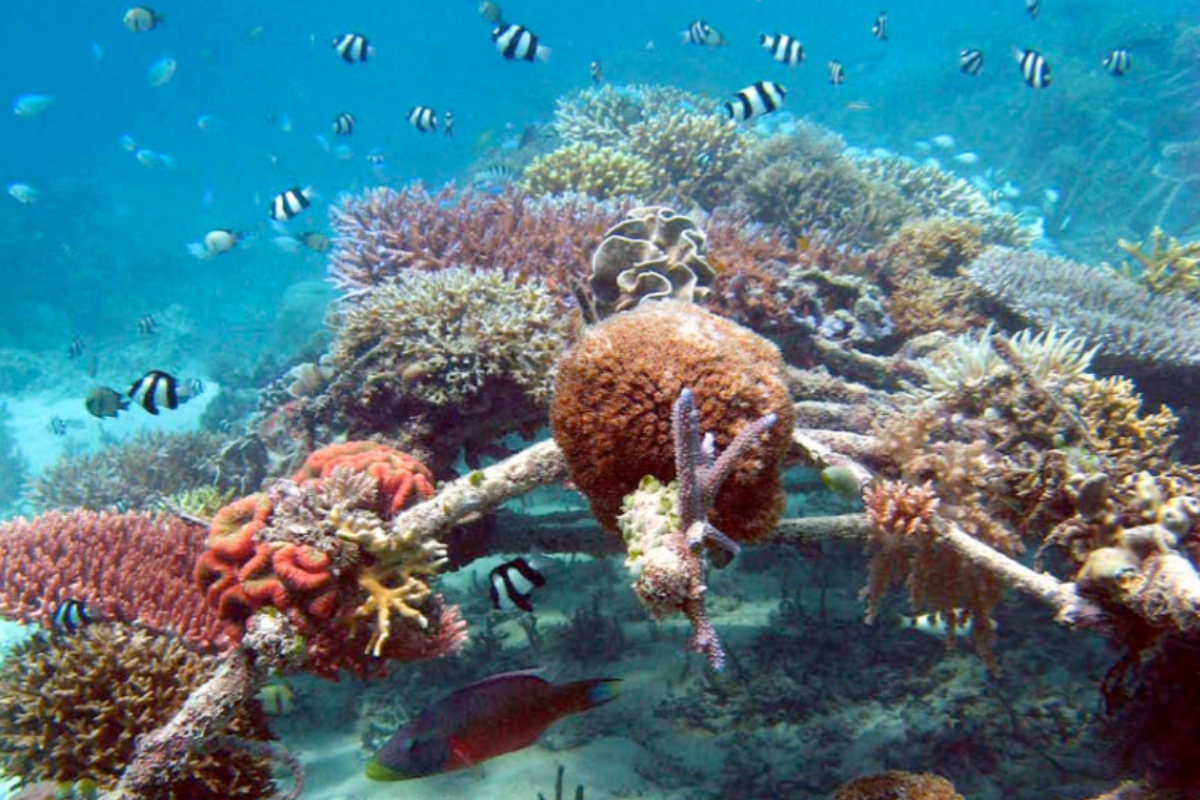
Thirty feet below the surface of Pemuteran Bay, the underwater world is strikingly quiet, dominated by the steady, mechanical hiss of a scuba regulator. When you hold your breath, the silence reveals a faint, static-like snapping sound—the crackle of snapping shrimp hiding in the remaining structures. The water here is warm and slightly turbid, filled with fine organic sediment and drift algae stirred up by coastal currents. On the seabed, the reality of historical degradation is clear: patches of grey, broken staghorn coral rubble lie scattered across the sand, dusted with a layer of greenish-brown turf algae that sways slowly in the surge. A few small damselfish dart between the surviving coral blocks, but the vast, complex architecture of the original reef has been flattened into a low, fragmented plain.
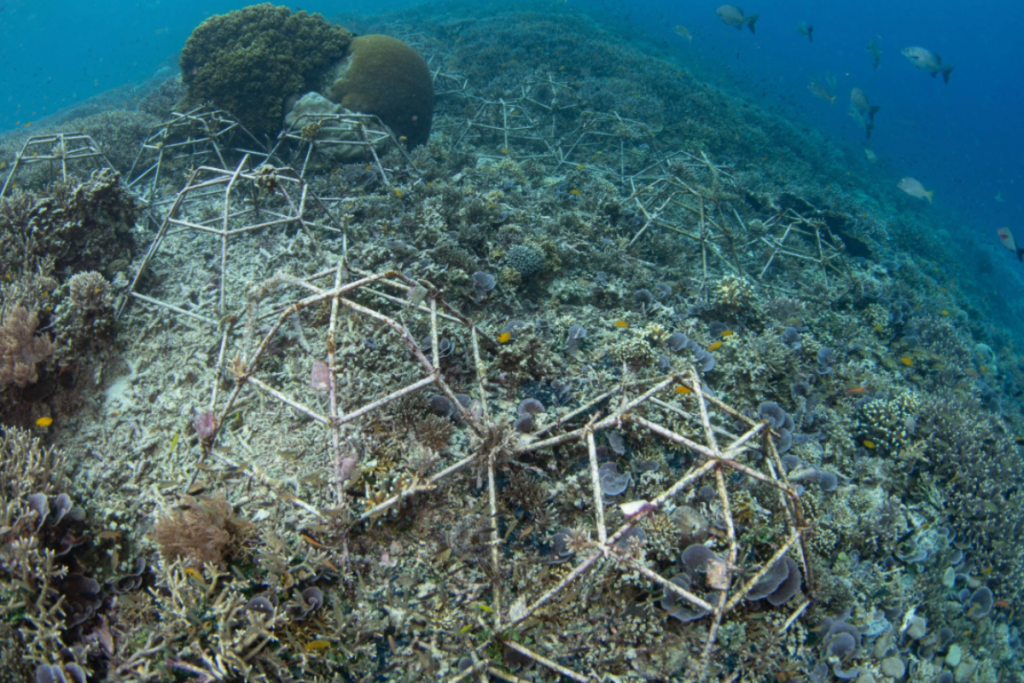
The initial structural groundwork: Geodesic steel frames deployed across the damaged marine shelf to kickstart substrate rehabilitation.
The original law of the reef
For the coastal Balinese of Pemuteran, the marine environment is governed by Tri Hita Karana, the foundational philosophy of life that mandates keeping three relationships in absolute equilibrium: harmony among people, harmony with the divine, and harmony with nature. Under this cosmological framework, the coral reef is not a passive economic resource, but a living sanctuary tied directly to the community’s spiritual and physical survival. Historically, stewardship of these nearshore waters fell under the jurisdiction of the Awig-Awig—traditional, locally enforced customary laws managed by the village council. These ancestral mandates controlled seasonal fishing limits, protected critical spawning grounds, and treated the marine shelf as a communal estate held in sacred trust for future generations.
A systemic break in the shelf
During the severe El Niño weather events of the late 1990s and early 2000s, escalating sea surface temperatures combined with destructive, non-traditional fishing practices—specifically dynamite and cyanide fishing—to trigger a catastrophic collapse across Pemuteran’s marine shelf. According to data tracked by the International Union for Conservation of Nature (IUCN), compounding thermal stress causes widespread coral bleaching, stripping the organisms of their symbiotic zooxanthellae algae and leaving the structural skeleton vulnerable to macroalgal smothering. As the complex three-dimensional habitat dissolved into flat rubble, local fish populations vanished. This ecological unraveling bypassed the authority of traditional Awig-Awig systems, as global climate shifts and commercial pressures overrode localized village management, leaving the community’s traditional fishing economy severely compromised.
Turning fishermen into technicians
In response to the collapse, a specialized, community-led deployment unit emerged under the Karang Lestari Foundation. Rather than relying on passive marine protected areas—which fail to restore already pulverized substrate—this tactical group stepped into the bay with an active intervention model. Working directly under the guidance of Pemuteran’s village elders and local dive operators, the foundation deployed an innovative intervention strategy known as Biorock technology. This approach turned the local fishermen from displaced operators into active field technicians, combining modern marine engineering directly with traditional community oversight.
The intervention relies on Mineral Accretion Technology, or Biorock engineering, originally developed by scientists Wolf Hilbertz and Dr. Thomas Goreau. Field technicians submerge heavy, open framework structures welded from ordinary construction steel rebar onto the barren sandy floor. These structures are connected via heavily insulated cables to a low-voltage, low-amperage direct current (DC) power source generated on land.
The electrical current passes through the steel skeleton (acting as a cathode) and flows to a separate anode. This localized electrical field triggers a chemical reaction in the seawater, causing dissolved calcium carbonate (limestone) and magnesium hydroxide minerals to naturally precipitate out of solution and coat the steel bars. This crystalline coating mimics the natural mineral substrate that coral larvae require for settlement. Field divers carefully salvage naturally broken, live coral fragments from the surrounding waters and attach them to the electrified frames. Because the low-voltage current handles the energetic cost of producing a skeletal base, the coral fragments grow at accelerated rates and display significantly higher resilience to bleaching events.
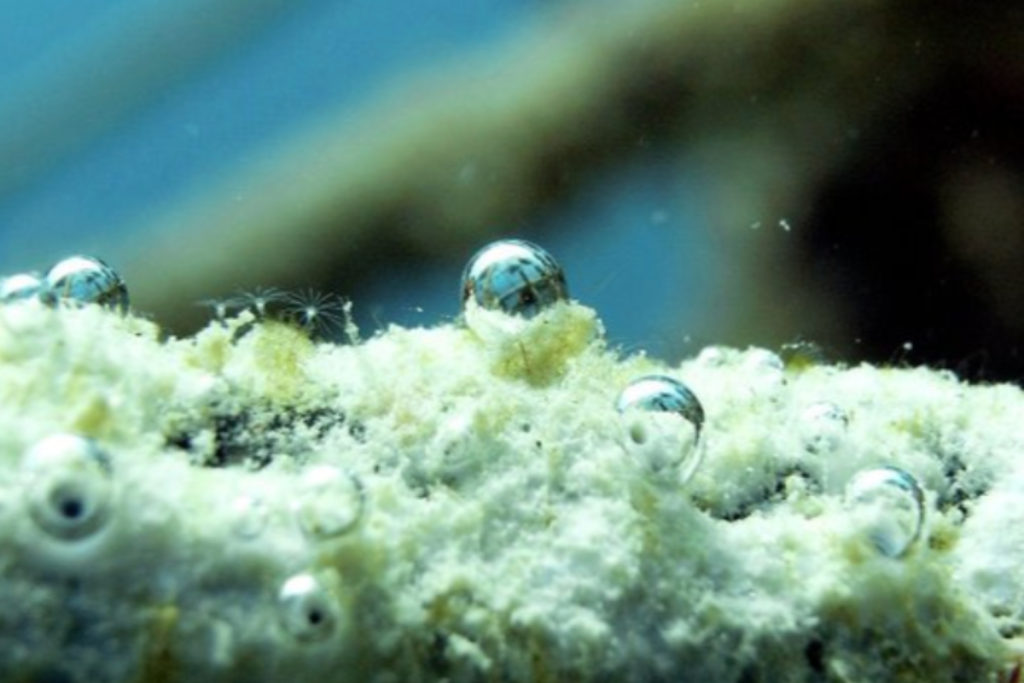
A close-up view of mineral accretion in action, where the active electrical current triggers the natural precipitation of a thick limestone crust directly onto the steel matrix. Photo: Wikipedia Commons.
The Numbers on the Seabed
Over two decades of field implementation, the Karang Lestari project has deployed more than 110 discrete Biorock structures across the Pemuteran coral reef nursery. Peer-reviewed field assessments verify that corals growing on these active mineral accretion structures exhibit growth rates up to six times faster than control fragments on non-electrified substrates. Furthermore, during regional thermal stress anomalies, survival rates for corals on the active arrays were recorded at numbers significantly higher than those on surrounding natural reefs.
However, the field operations face unvarnished structural bottlenecks. Maintaining continuous, low-voltage power supply to over 100 underwater structures requires consistent shore-based electrical infrastructure. Frequent grid fluctuations, lightning strikes on coastal power hubs, and heavy winter storm surges regularly sever or short-circuit underwater power lines. When a structure loses its electrical charge, the accelerated mineral accretion halts immediately, leaving the young corals dependent on their own compromised metabolic rates in warming waters.
WHY THIS MATTERS
Pemuteran Bay represents just a tiny fraction of the world’s remaining coral reef systems. Yet, this localized shelf serves as a critical global baseline. If low-voltage mineral accretion can successfully insulate sensitive marine organisms from localized thermal spikes here, the methodology can be scaled across the broader Coral Triangle—an underwater habitat that supports over 500 species of reef-building corals and acts as the economic backbone for millions of coastal people. Pemuteran isn’t just a local nursery; it is the blueprint for active, climate-resilient marine architecture.
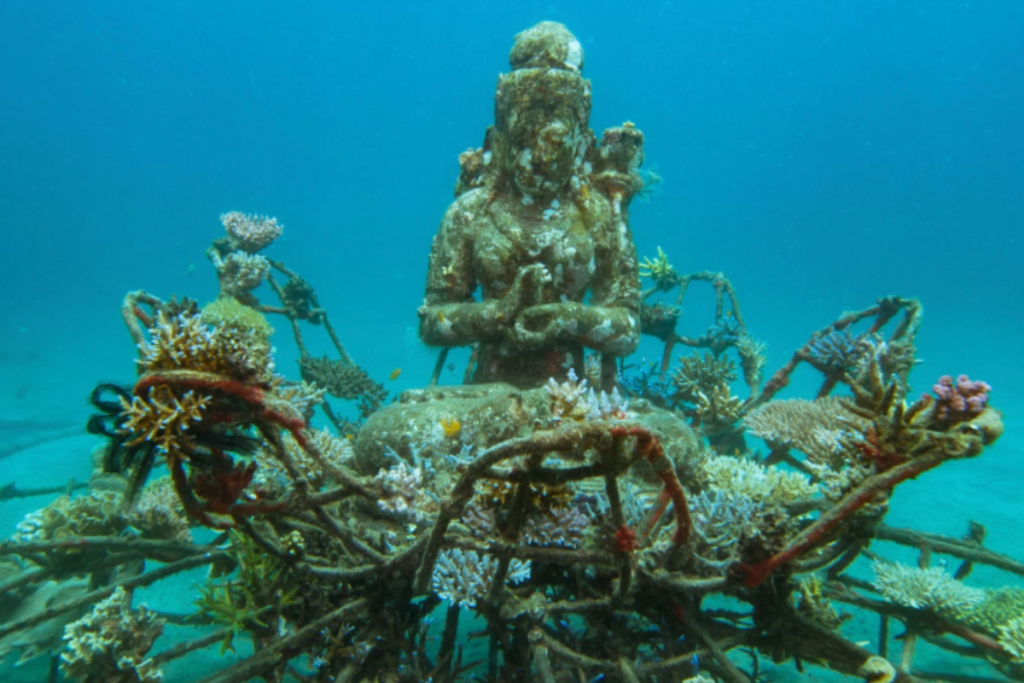
The mature ecosystem model: an electrified coral nursery structure in Pemuteran completely covered in flourishing coral colonies and attracting wild marine life. Photo: Getty Images.. Source: Francesco Ricciardi / Getty Images
A modern tool doing old work
“When the dynamite fishing stopped, we were left with a desert of dead white stones,” says Komang Prana, a local Balinese diver and senior reef technician with the foundation. “Our elders taught us that if you break the connection to the sea, you break the village. Welding these iron structures underwater felt strange at first, but when you watch the wild limestone crust form over the bare metal in just a few weeks, you realize it is just a modern tool doing the old work. The fish have returned because they recognize a home, and our youth are learning how to defend it again.”
As evening settles over Bali, solar arrays on the Pemuteran shoreline transition to battery banks, maintaining the faint, invisible current flowing down into the bay’s nursery structures. The survival of these ecosystems no longer depends on passive isolation, but on active, sustained technological and human guardianship. What began as a localized community stand in Pemuteran Bay has evolved into a nationwide methodology, bridging local ancestral custody with scalable marine engineering.
To view detailed project maps, track ongoing coral survivorship datasets, or support the frontline maintenance teams on the ground, interface directly with the operational center at the Karang Lestari Coral Reef Restoration Project, or explore how this blueprint is being scaled across the archipelago through Biorock Indonesia.