
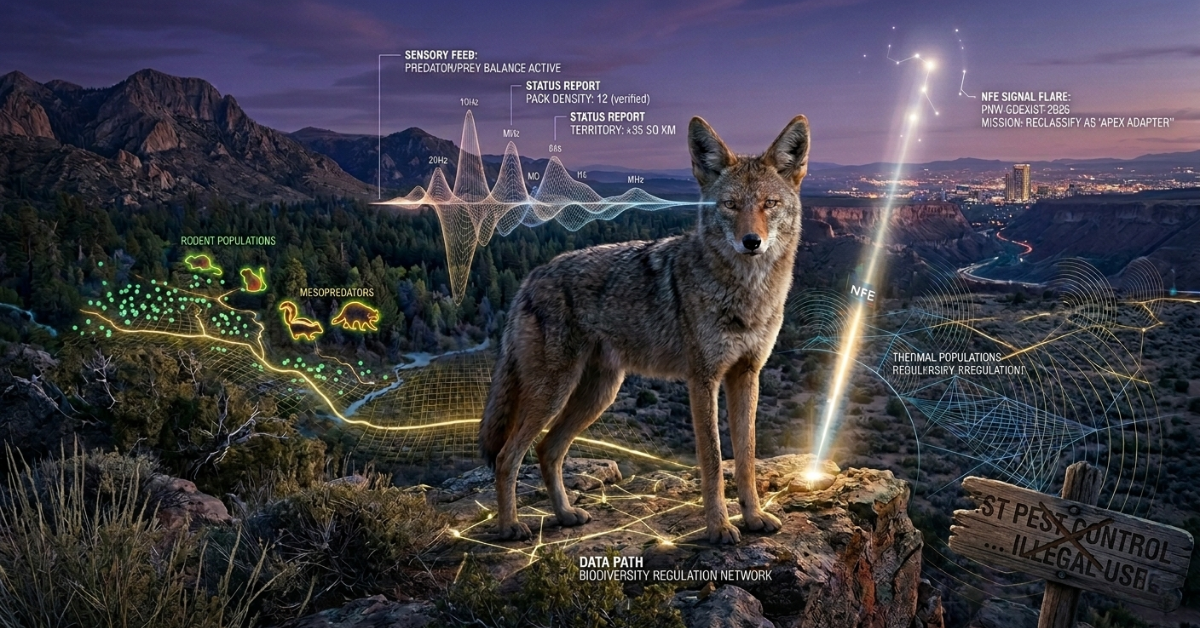
The Intel Brief
Mission: To reclassify the Coyote from “nuisance” to “Essential Continental Regulator” and “Apex Adapter.”
The Midnight Choir: Why the Coyote is North America’s Most Successful Security Detail
The First Trickster: Old Man Coyote is the ‘Medicine Dog’ of the land whose song keeps the world awake and whose presence ensures the balance of the wild remains unbroken.
Key Takeaway: As the primary stabilizer of North American biodiversity, the Coyote manages mesopredator populations and regulates rodent cycles, directly protecting songbird habitats and preventing “biological inflammation” across the continent.
Time to Read: 8 Minutes
The Acoustic Signature: The Continental Nervous System
The Status Report
Imagine you are parked on a dark forest service road, or perhaps tucked into a quiet suburban cul-de-sac where the pavement meets the scrub. The silence of 2:00 AM is suddenly shattered. It starts with a single, rising lope—a lonely, mournful pull of air—and is instantly answered by a chaotic explosion of yips, barks, and “shrieks” that seem to come from everywhere and nowhere at once.
To the uninitiated, this is “spooky” or “menacing.” To the rancher, it has historically been seen as a threat. But at Network for Ecology, we decode the signal. This isn’t a random celebration; it is a Status Report. This is the Sovereign Song Dog checking in. It is the sound of a high-tier biological operative reporting back to the pack and the landscape itself.
The Science of the Song: The Acoustic Census
The “yip-howl” of the Coyote (Canis latrans) is not merely a wild soundtrack; it is one of the most sophisticated communication arrays in the North American animal kingdom. New research and field observations, such as those cataloged by Project Coyote, suggest these vocalizations serve as a real-time Acoustic Census, a biological data-stream that maps the presence of the pack across the “Continental Nervous System”—a landscape stretching from the Alaskan tundra to the tropical corridors of Panama.askan tundra to the tropical forests of Panama.
The Master of Resilience: The 40% Expansion
While other apex predators retreated or vanished in the face of human expansion, the Coyote did the impossible: it leaned in. A landmark study published in ZooKeys reveals that since the 1950s, while the United States waged a literal war on the species using traps, poisons, and “killing contests,” the Coyote responded by expanding its range by 40%.
They are the ultimate survivor—the only major predator to thrive in the shadow of the Anthropocene. They have successfully infiltrated every major U.S. city, not as “strays,” but as masters of the environment. While we spent billions trying to silence the song, the Coyote simply adjusted its frequency, proving that true power isn’t found in dominance, but in the unshakeable ability to adapt.
The Continental Footprint: A Range Without Rival
The Coyote is the ultimate “habitat generalist,” executing a continental expansion that defies modern extinction trends. Historically restricted to the open prairies of the American West and Mexico, this apex-adaptor has increased its geographical footprint by over 40% since the mid-20th century.
Today, their “pack presence” is absolute across a “Continental Nervous System” that spans nearly every ecological niche:
- The Northern Anchor: They have pushed deep into the Alaskan interior and the Canadian Yukon, colonizing the boreal forests and the fringes of the Arctic tundra.
- The Eastern Expansion: In less than a century, they successfully migrated across the Mississippi, established a presence in the high-density urban corridors of New York and Chicago, and claimed the forests of the Atlantic coast.
- The Southern Vanguard: Most notably, coyotes have moved through the tropical forests of Central America, crossed the Panama Canal, and are currently documented at the edge of the Darién Gap—the final jungle barrier before the South American continent.
Unlike many species that require pristine wilderness, the coyote thrives in the “cracks” of human civilization. By utilizing agricultural edges, suburban greenbelts, and deforested transit corridors, they have become the first major predator to effectively “re-wild” the entire North American landmass in the wake of larger apex predator declines.
The Biological Machine: Architecture of the Apex Adapter
To understand why the Coyote is the “Foreman of the North,” we must look past the fur and see a high-performance biological machine engineered for the long game. Unlike the Jaguar, which relies on the physics of a singular, crushing strike, the Coyote is built for Kinetic Endurance and Genetic Redundancy.
Kinetic Performance: The Pursuit Athlete
The Coyote’s frame is a masterclass in versatility. Capable of hitting sustained sprint speeds of 43 MPH, they can outrun almost any domestic threat and maintain a pace that exhausts larger, less efficient competitors. This isn’t just flat-ground speed; the Coyote is a vertical operator, capable of clearing 14-foot obstacles and jumping fences that are designed to keep them out.
The Sensory Array: Mapping the Chemical Landscape
The Coyote doesn’t just see the world; it “smells” the past and the future. With over 200 million olfactory receptors—compared to a human’s 5 million—the Coyote’s nose functions like a high-resolution 3D scanner. According to research on canine sensory perception, they can detect chemical signatures from miles away, allowing them to avoid human “kill zones” and identify the precise moment an ecosystem’s rodent population is reaching a “Biological Inflammation” point.
The Fail-Safe Mechanism: Compensatory Reproduction
This is the Coyote’s most advanced “Software Update.” Most species collapse under heavy hunting pressure; the Coyote does the opposite. Through a biological phenomenon known as Compensatory Reproduction, when the pack density is reduced by human trapping or poisoning, the surviving females undergo a hormonal shift.
Their bodies respond by releasing more eggs per cycle, resulting in larger litter sizes. According to This study, this “rebound effect” means that unless you eliminate 70% of a population every single year, the population will actually grow in response to the attack.
The Ecosystem Regulator: The Foreman of the Field
The Coyote does not just inhabit the landscape; it manages it. By acting as the Continental Regulator, the Coyote maintains the “Landscape of Fear,” a psychological and biological boundary that prevents total ecosystem collapse.
Mesopredator Management: The Security Detail
One of the Coyote’s most critical roles is policing “mesopredators”—mid-sized carnivores like raccoons, skunks, foxes, and feral cats. In areas where Coyotes are absent, these smaller predators experience a population explosion, leading to a phenomenon known as Mesopredator Release.
By maintaining a dominant presence, the Coyote acts as a Security Detail for Biodiversity, ensuring that songbirds and ground-nesting waterfowl have the space to thrive.
The Rodent Pressure Valve: Preventing Biological Inflammation
Coyotes are the primary pressure valve for rodent cycles across the continent. A single Coyote can consume thousands of rodents in a single year. By keeping rodent populations in check, the Coyote directly reduces the spread of zoonotic diseases (such as Lyme disease and Hantavirus) and prevents the “over-grazing” of native grasslands.
Hydrological Stability: Anchoring the Riparian Zone
Just as the Jaguar anchors the rivers of the Amazon, the Coyote stabilizes the waterways of North America. By regulating the behavior of large herbivores and rodents near riverbanks, they prevent the over-consumption of riparian vegetation. As noted by The Rewilding Institute, the presence of this apex adapter is a fundamental requirement for a healthy, functioning watershed.
CRITICAL THREAT ASSESSMENT: The Sabotage of the Sentinel
While the Coyote is a master of adaptation, it is currently facing a threat it cannot outrun: Mindless Ecological Sabotage. This is a systemic chemical infiltration that turns the Coyote’s own efficiency against it. We call this Relay Toxicosis.
The Relay Toxicosis Trap: Turning Strengths into Vulnerabilities
Because the Coyote is the “Foreman of the Field,” it naturally targets the weak. When humans deploy rodenticides, they create a lethal trap. Poisoned rodents become slow and lethargic. To a Coyote, this looks like a successful hunt. In reality, they are consuming a high-volume payload of toxins. According to the National Audubon Society, this secondary poisoning is decimating predators across the continent.
The Chemistry of Collapse: SGARs and Internal Breaches
The most dangerous tools in this chemical war are Second-Generation Anticoagulant Rodenticides (SGARs). These are bioaccumulative weapons that persist in the liver for over 100 days.
- The Uncontrollable Bleed: These toxins block the body’s ability to utilize Vitamin K, which is essential for blood clotting.
- The Immune Shutdown: Even if the dose isn’t fatal, it shatters the immune system. This is why we see “mange-ridden” Coyotes; they are often immunologically compromised by sub-lethal poisoning.
The Generational Hit: Losing the Future
The sabotage doesn’t end with the adult. Adult Coyotes bringing poisoned prey back to the den results in the death of entire families. As documented by the Connecticut Audubon Society, we are wiping out the next generation of ecological regulators before they ever take their first shift.
Beyond Anticoagulants: The Neurotoxin Frontier
While SGARs are the most common, other poisons like Bromethalin target the brain directly, causing tremors, seizures, and hind-limb weakness. Others, like Cholecalciferol (Vitamin D3), cause a massive calcium overload that leads to kidney failure and heart calcification. This isn’t “pest control”—it is the systematic dismantling of North America’s natural nervous system.
The Frontier Sentinel: The Modern Infiltrator
Despite the chemical warfare and the centuries of attempted eradication, the Coyote has done what no other North American predator has managed: it has successfully occupied the heart of the human empire. They are not “lost” or “stray”; they are the most successful mammalian adapters of the 21st century.
Urban Mastery: The Invisible Neighbor
In cities like Chicago, Los Angeles, and New York City, Coyotes have moved beyond mere survival and into full integration. According to the Urban Coyote Research Project, urban Coyotes have developed a specialized behavioral “Software Update.” They have become almost entirely nocturnal to avoid human conflict, and they have learned to navigate complex traffic patterns and subway tunnels with surgical precision.
They are living among millions of people, often unnoticed, performing their role as the Urban Security Detail by keeping rodent and feral cat populations in check. They are the only apex adapters capable of maintaining ecological function within a concrete jungle.
The “Coywolf” Frontier: Genetic Fluidity as a Shield
As the Coyote moved East, it encountered the vacuum left by the extermination of the Grey Wolf. Instead of fading away, the Coyote utilized Genetic Fluidity. By interbreeding with remnant wolf populations and domestic dogs in the Northeast, a new “sub-species” or hybrid has emerged—often colloquially called the Coywolf.
These animals are larger, more social, and possess a more powerful jaw structure, allowing them to fill the role of a true apex predator in the Eastern forests. This isn’t a “mutation”; it is the Earth’s way of stitching its own circulatory system back together. The Coyote is the primary thread.
The Frontline Alliance: Elevating the Guardians
We are not alone in this fight. Network for Ecology is bridging the gap between ancient biological resilience and modern field intelligence by connecting and elevating the frontline allies who are shielding the Song Dog during this critical 2026 window. We prioritize these organizations because they focus on Restoration over Dominance.
- Project Coyote: Ending the War on Wildlife Based in Northern California but operating across the continent, Project Coyote is the tactical leader in the fight to end “Wildlife Killing Contests.” They work to replace archaic, fear-based management with science-based protocols. By advocating for the “Sovereign Song Dog,” they ensure that the Coyote is recognized as a vital apex adapter rather than a “nuisance” to be eradicated.
- Deploy the Intelligence: ProjectCoyote.org
- R.A.T.S. (Raptors Are The Solution): Defeating the Chemical Trap This alliance is the primary intelligence hub for exposing the “Mindless Sabotage” of rodenticides. R.A.T.S. works tirelessly to educate municipalities and homeowners on the lethal legacy of Second-Generation Anticoagulant Rodenticides (SGARs). They provide the roadmap for the “Mechanical Over Chemical” shift, advocating for the natural “Security Detail” of predators to handle rodent cycles without the collateral damage of secondary poisoning.
- Deploy the Intelligence: RaptorsAreTheSolution.org
- The Urban Coyote Research Program: Decoding the Infiltrator This program provides the data-driven shield for urban populations. By using radio-telemetry and long-term monitoring in major hubs like Chicago, they prove that Coyotes are not a threat to public safety, but are instead a High-Performance Infrastructure asset. Their research is the primary weapon against “fear-based” policies in the concrete jungle.
- Deploy the Intelligence: UrbanCoyoteResearch.com
- The Rewilding Institute: Mapping Sovereign Corridors Strategists at The Rewilding Institute view the Coyote as the “connective tissue” of the North American continent. They focus on continental-scale connectivity—the “Spine of the Continent”—ensuring that Sovereign Corridors remain open so that Coyotes can safely move between fragmented wild hubs. Their work ensures that the genetic flow remains uninterrupted across the landscape.
- Deploy the Intelligence: Rewilding.org
- Coyote Watch Canada: The Coexistence Model A vital ally for our northern corridors, focusing on “Community-Based Coexistence.” They are masters at de-escalating human-coyote conflict through education and aversive conditioning, proving that the Song Dog and the human can occupy the same map without conflict.
- Deploy the Intelligence: CoyoteWatchCanada.com
Isolated Teaching: The Coyote’s Curriculum
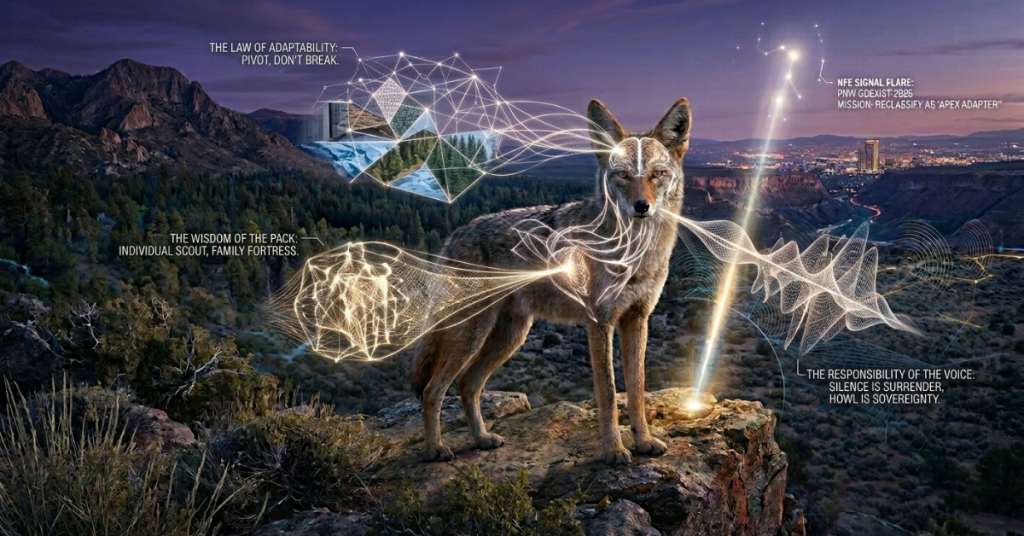
Indigenous cultures have long understood what modern data is only now verifying: the Coyote is the continent’s master of survival and the primary teacher of Strategic Persistence. In this isolated curriculum, we find the blueprints for our own sovereignty, designed to be integrated into one’s own life journey:
- The Law of Adaptability: Power is not found in rigidity, but in the ability to pivot. Survival belongs to the one who can find the path through the concrete jungle and the frozen tundra alike.
- The Wisdom of the Pack: The individual is a scout, but the family is the fortress. Success is a collective resonance; when one of us finds the way, we all find the way.
- The Responsibility of the Voice: To speak (or howl) is to claim your territory and report your status. Silence is for those who have surrendered their mission; your roar—or your yip—is your sovereignty in action.
A Personal Commitment
“I have spent many nights parked on the edge of the map, where the suburban streetlights fade into the scrub. In those 3:00 AM hours, when the rest of the world has retreated behind locked doors, I’ve sat and listened to the ‘Midnight Choir’, while camping in Ocala National Forest. It’s a sound that stops you in your tracks—a chaotic, electric frequency that cuts through the dark.
I don’t hear a ‘pest’ or a ‘nuisance’ when the Coyote howls. I hear a sovereign foreman, and my feral friend, clocking in for the night shift. While we sleep, they are patrolling the corridors, policing the rodent cycles, and keeping the mesopredators in check. They are the only ones working the late shift.
My commitment to the Coyote is rooted in my respect for their absolute refusal to be broken. For a century, we have thrown every trap, every bullet, and even chemical weapon at them, and they responded by becoming smarter, stronger, and more connected.
But even their legendary resilience has a breaking point. It’s hard to speak about the modern-day cruelty we still see—the ‘hunting’ packs of hounds and houndsmen that run these animals to the point of complete, agonizing exhaustion. It is a mirror image of the trauma we see out West with the Wild Mustang roundups, where sovereign spirits are chased by helicopters and machines until their hearts and hooves literally give out. There is no ‘fair chase’ in a machine designed to run a creature into the ground for sport or ‘management.’ It’s a gut-wrenching, senseless display of dominance over a species that is actually trying to help us.
Coupled with the ‘Mindless Sabotage’ of secondary poisoning, we are looking at a coward’s war that turns the Coyote’s predatory brilliance into a death sentence for their entire family. At Network for Ecology, we aren’t interested in ‘managing’ the Coyote; we are interested in ending the sabotage and the cruelty. I am standing with the frontline allies like Project Coyote and the others.
I’m asking you to stand with me. Stop the poisoning. End the exhaustion. Start the respecting. It’s time to listen to what the Song Dog is actually telling us.”
THE FIELD QUERY
If the Coyote can thrive in the heart of Los Angeles and the depths of the Yukon alike, what “hostile environment” in your life are you currently avoiding instead of adapting to? Is it time to stop asking for permission and reclaim your roar?
SENDING A SIGNAL FLARE
Recruit the Pack. This mission only succeeds if the network grows and the signal stays loud. Do not let this intelligence die on your screen. Share this dispatch across your social channels to help us elevate the frontline guardians of the sovereign pulse. Every share is a digital signal flare that proves our allies are no longer standing alone.
Signature: Dale Hoskins, Conservation Commerce Strategist for Network for Ecology.