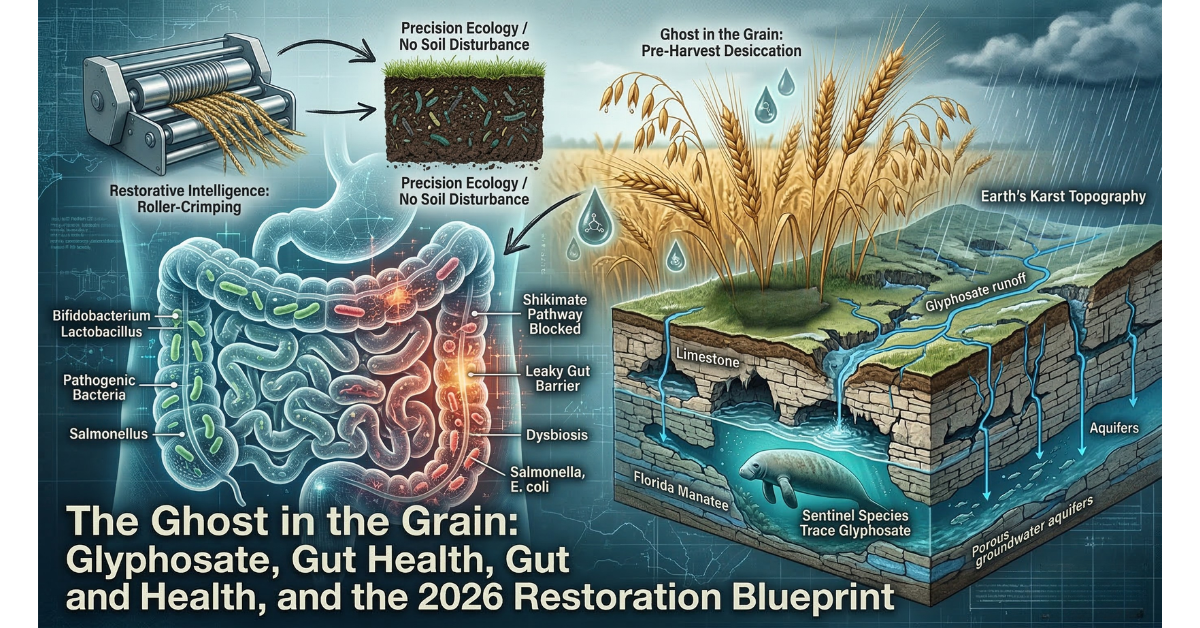
Mission: To synthesize the transition from chemical dependence to restorative intelligence while exposing the pre-harvest desiccation “shortcut.”
Key Takeaway: While recent executive maneuvers create legal shields for glyphosate, the biological reality of gut dysbiosis and the economic rise of laser weeding are making industrial herbicides obsolete.
Time to Read: 12 minutes
The war on “weeds” has reached its biological and legal limit. As of early 2026, the global glyphosate market has surged to $13 billion, with an application volume hitting roughly 1.65 billion lbs annually. This volume represents a fundamental misunderstanding of the Earth’s circulatory system. To heal the planet, we must first understand the “mess” we are currently irrigating with industrial chemistry.
I. The 2026 Policy Battleground: DPA vs. HR 7601
The landscape of environmental law shifted overnight on February 18, 2026, when the White House invoked the Defense Production Act (DPA). By designating glyphosate—the world’s most widely used herbicide—as a “critical material” for national security, the administration effectively militarized the supply chain.
The Section 707 “Liability Shield”
The core of this strategic move lies in Section 707 of the DPA. This provision grants manufacturers a broad “immunity from liability” for any damages resulting from their compliance with federal production orders.
The Industry Loophole: Historically, chemical giants have faced billions in litigation over glyphosate’s links to non-Hodgkin lymphoma and other health crises. Under this 2026 designation, the companies argue that because the government has ordered the production for “national security” (food supply stability), they can no longer be held liable for the long-term health consequences of the product.
The Federal Override: This act attempts to supersede state-level “failure to warn” laws, effectively silencing the legal recourse of citizens and local governments.
The Counter-Strike: H.R. 7601
In a rare moment of bipartisan “Mission-Direct” alignment, Rep. Thomas Massie (R-KY) and Rep. Chellie Pingree (D-ME) introduced H.R. 7601, the “No Immunity for Glyphosate Act,” on February 20, 2026.
The Argument: Rep. Massie, a self-described “constitutionalist farmer,” argues that using wartime authorities to insulate multi-billion dollar corporations from the consequences of their chemical products is a fundamental breach of sovereignty.
The Objective: H.R. 7601 seeks to explicitly strip DPA-related immunity from glyphosate manufacturers. It asserts that “National Security” should be defined by the health of the citizens and the soil, not the profit margins of the chemical monopoly.
II. Tracing the Runoff: The Global Circulatory Crisis
When chemical manufacturers label their products “safe” based on their ability to bind to soil, they are ignoring the reality of the Earth’s complex “circulatory system.” Chemicals don’t simply stay where they are sprayed; they migrate through the soil and into the massive underground reservoirs that provide drinking water for billions.
The Infiltration: Leaching into the Earth’s Veins
Across the globe, roughly 7.2% of applied pesticides leach directly into groundwater annually. In regions dominated by Karst Topography—landscapes made of soluble rocks like limestone—surface runoff doesn’t just sit on the topsoil. It drops through sinkholes and fractures directly into primary aquifers. Whether you are over the Floridan Aquifer in the U.S. or the Great Artesian Basin in Australia, the porous nature of the Earth means our “waste” is a direct deposit into our future drinking supply.
The Biological Pulse: A Record of Systemic Stress
The presence of these chemicals is not just a geological concern; it is a biological reality recorded in the blood of the voiceless.
The Sentinel Species: While a landmark study detected glyphosate in the plasma of 55.8% of sampled Florida Manatees, this is merely a regional data point for a global phenomenon.
Widespread Accumulation: Similar trends are appearing in aquatic life across the world’s major river systems, from the Rhine to the Mississippi. These species serve as the “canary in the coal mine,” signaling that the Earth’s internal systems are losing their ability to filter out industrial toxicity.
Verified Intelligence: Sources & Links
For those tracking the movement of these chemicals through our global water system, the following datasets provide the technical foundation for our reconnaissance:
III. The Gut-Soil Connection: The “Shikimate” Blind Spot
The industry’s defense of glyphosate hinges on a strategic half-truth: because human cells lack the Shikimate pathway, the chemical is essentially “inert” once ingested. However, this ignores the foundational reality of human biology—the gut microbiome, which serves as our internal soil.
The Selective Antibiotic Effect
While your human cells are technically “immune” to glyphosate’s primary mechanism, the trillions of bacteria in your digestive tract are not. Glyphosate’s role as a potent antimicrobial is a legal and biological reality.
The Antimicrobial Patent: In 2010, the U.S. Patent and Trademark Office granted Patent No. 7,771,736 to Monsanto for glyphosate’s use as a parasitic protocidal control (antimicrobial).
The Vulnerable Allies: Scientific analysis reveals that 54% of species in the core human gut microbiome are potentially sensitive to glyphosate. Crucial beneficial bacteria like Bifidobacterium and Lactobacillus are among the most susceptible because they rely on the Class I EPSPS enzyme in the Shikimate pathway.
The Resistant Pathogens: Opportunistic pathogens such as Salmonella, Clostridia, and E. coli often possess a resistant “Class II” EPSPS enzyme or efflux pumps. Exposure creates a “vacuum” where beneficials die off and pathogens flourish—a state of Dysbiosis that is a clinical hallmark of IBS.
The industry frames Celiac disease as a simple, rising genetic intolerance to gluten. However, the data suggests a more complex, environmental etiology. Celiac disease is a multifactorial condition defined by systemic breakdowns that map perfectly to glyphosate’s known biological properties:
The Enzymatic Blockade: Glyphosate inhibits Cytochrome P450 (CYP) enzymes. These are the “master regulators” that detoxify environmental chemicals and activate Vitamin D3. When CYP enzymes are suppressed, the body’s ability to maintain the sulfate supply required for gut lining repair is crippled.
The Metal Chelation Trap: Glyphosate was originally patented as a pipe cleaner because it is a powerful chelator—it “grabs” and binds to metals. In the human gut, it locks up iron, molybdenum, and selenium, making these transition metals unavailable for absorption. This explains the chronic nutrient deficiencies seen in Celiac patients.
The Amino Acid Depletion & Serotonin Crash: By disrupting the Shikimate pathway in our gut bacteria, glyphosate depletes tryptophan, tyrosine, and methionine. This leads to impaired serotonin signaling (the gut-brain connection) and an overproduction of toxic metabolites like p-Cresol.
The Sulfate Supply Crisis: A key system-wide pathology in Celiac disease is the impaired sulfate supply to the tissues. Sulfate is the “biological grease” of our systems; without it, cellular waste builds up and the protective mucosal layer of the gut disintegrates.
The Chelation Patent:U.S. Patent 3,160,632 – Verification of its original use as a chemical chelator.
Erosion of the Barrier: The “Leaky Gut” Mechanism
The integrity of your gut depends on tight junctions—microscopic protein gates (like ZO-1 and Occludin) that act as the mortar between cells, preventing undigested food and toxins from entering the bloodstream.
Structural Failure: Research published in 2025 and 2026 continues to demonstrate that glyphosate decreases Transepithelial Electrical Resistance (TEER), a measure of barrier strength. It has been shown to directly disrupt the ZO-1 tight junction element, forcing the gut barrier to fail.
Zonulin Activation: High-level research suggests glyphosate may trigger the release of Zonulin, a protein that signals the opening of these gates. Once breached, the body enters a state of persistent immune activation, leading to autoimmune “flares.”
Microbiome Reconnaissance: Restoration Protocols
We don’t just track the damage; we map the extraction. To repair the gut-soil connection, we utilize targeted microbial reinforcements that have shown resilience to chemical stress.
The Keystone Shield:Lactobacillus reuteri and Bifidobacterium infantis can improve the localization of occludin, effectively “re-sealing” junctions.
Soil-Based Organisms (SBOs): Strains like Bacillus subtilis are spore-forming “paratroopers” that crowd out the Clostridia blooms triggered by glyphosate.
The Glyphosate Degraders: Emerging research into Acetobacter suggests these microbes can actually utilize glyphosate as a phosphorus source, breaking it down before it causes damage.
Saccharomyces boulardii: This beneficial yeast is inherently immune to the Shikimate-targeting mechanism, serving as a “scaffold” for the microbiome during recovery.
The Dead Zone: Just as glyphosate sterilizes soil by killing the fungi that facilitate nutrient uptake, it sterilizes the gut. This leads to “suboptimal nutrient availability,” where the body is energy-starved despite high caloric intake.
Restoration Intelligence: Healing the pack requires moving away from chemical sterilization. We prioritize data from the 1,000 Farms Initiative, which highlights how regenerative systems restore the microbial “invisible frontline.”
IV. The “Ghost in the Grain”: Pre-Harvest Desiccation
The most direct route for glyphosate to enter our food supply isn’t through the soil or groundwater—it is through a practice known as pre-harvest desiccation. This involves spraying the herbicide directly onto standing grain crops (like wheat, oats, and barley) just days before they are harvested.
The Industry “Shortcut”
While herbicides are traditionally used to kill weeds early in the growing season, desiccation uses glyphosate as a chemical drying agent. In industrial agriculture, uniform ripening is rare; one side of a field may be dry while the other remains green.
The “Kill” Signal: Spraying glyphosate forces the entire crop to die simultaneously, speeding up the drying process and allowing farmers to run their combines on a predictable schedule regardless of weather.
The Residue Trap: Because this application happens at the end of the crop’s life cycle, the plant has no time to metabolize or break down the chemical. The glyphosate is absorbed into the grain head—the part we eventually grind into flour.
Verified Technical Sources
Process & Methodology: The University of Minnesota Extension documents that glyphosate is used as a pre-harvest option to “hasten wheat crop dry-down” and ensure “more even ripening compared to untreated standing grain.”
The “Desiccation” Strategy:EcoWatch details the historical shift from traditional “swathing” (cutting and drying in rows) to chemical desiccation, noting that in regions like Saskatchewan, nearly all non-organic farmers utilize this practice.
Technical Constraints:Bayer Crop Science Canada confirms that while they frame it as “weed management,” the result is a systemic plant death that reduces whole-plant moisture for “harvest management benefits.”
Market Rejection: The reality of this contamination is so high that major buyers like Richardson International and Kellogg’s have initiated phase-outs of glyphosate-desiccated oats and wheat due to consumer quality and health concerns.
The Extraction Insight: We are effectively “curing” our bread with a systemic herbicide. This isn’t a side effect of farming; it is a design feature of an industrial system that prioritizes mechanical efficiency over the integrity of the human gut.
The Warrior and the Trial: Moms Across America & The Trial Evidence
While federal policy maneuvers in early 2026 attempt to shield chemical manufacturers, the most critical “frontline intelligence” is being gathered by those who see the biological impact first. Zen Honeycut, founder of Moms Across America, has transformed maternal intuition into a global research network. Under her leadership, the organization pioneered independent lab testing that exposed the “Ghost in the Grain” long before federal agencies acknowledged its scale. Their 2024–2026 data revealed that 90% of popular American children’s cereals and 93% of school lunch items tested positive for glyphosate residues, forcing a national conversation on the Shikimate Blind Spot. Honeycut’s work serves as a “Signal Flare,” proving that food sovereignty begins with the right to know exactly what is being irrigated into our children’s bodies.
This grassroots reconnaissance is built on the legal foundation laid by Robert F. Kennedy Jr. during his career as a trial lawyer. Kennedy was a lead architect in the legal dismantling of Monsanto’s narrative, most notably in the 2018 Dewayne “Lee” Johnson case. His team secured a landmark $289 million verdict (later reduced to $78 million) by forcing the discovery of the “Monsanto Papers”—internal documents that exposed a pattern of scientific ghostwriting. By March 2026, the litigation fallout he helped ignite has led to over $11 billion in settlements already paid by Bayer, with a new $7.25 billion class-action settlement currently under judicial review. While Kennedy’s 2026 role as HHS Secretary involves complex navigation of the Defense Production Act, his trial record remains the cornerstone of glyphosate accountability, proving that juries will hold chemical giants liable when presented with the raw reality of a “failure to warn.”
“To protect the integrity of our food supply and the health of the next generation is to help nature thrive, strengthen species, and save wild places, inspiring a global movement shifting the consciousness of mankind to protect the living Earth”.
The “Triple-Digit” Findings
In February 2026, the Healthy Florida First Initiative released independent laboratory results confirming that industrial chemical residues have moved from the field directly into the family pantry. While federal agencies maintain high “safe” thresholds, these state-level findings expose the quiet, systemic presence of glyphosate in staple national brands.
The Florida Department of Health (DOH) conducted rigorous testing on eight bread products across five major brands. The results are a clear signal of the “Ghost in the Grain” phenomenon: 6 out of 8 products tested positive for glyphosate.
State Briefing: Florida Department of Health News Release (Feb 2026)
The Extraction Insight: The massive delta between “Wonder Bread” (173.19 ppb) and “Dave’s Killer Bread” (11.85 ppb) proves that clean sourcing is possible. The lower numbers in Dave’s Killer Bread reflect a “Restorative Intelligence” in the supply chain—choosing grains that weren’t subjected to pre-harvest desiccation.
State Surgeon General Dr. Joseph Ladapo highlighted that while these levels are within current federal “tolerance” limits, they are deeply troubling when considering the cumulative risk of chronic exposure. “Bread is a staple food for many Florida families, and they should be able to consume it without worrying about toxins,” Ladapo stated, citing research that links such exposure to disruptions in the gut microbiome and liver inflammation.
The Global Contrast
This practice is increasingly seen as a relic of an outdated, chemical-first era. In 2022, the European Union moved to restrict glyphosate’s use as a desiccant, and many Nordic countries have banned the practice entirely. They have recognized what the 2026 data confirms: that using a systemic poison as a “harvest aid” is a fundamental breach of food sovereignty.
V. Restorative Intelligence: The Multi-Scale Extraction
We are no longer limited to the spray bottle. The transition to Precision Ecology is being led by a new vanguard of methods that prioritize biological integrity over chemical dominance. Whether on a 5,000-acre industrial block or a 5-acre family homestead, these tools represent a fundamental extraction from the chemical loop.
1. The High-Tech Scalpel: AI Laser Weeding
For large-scale operations, technology like the Carbon Robotics LaserWeeder™ represents a massive leap in “Restorative Intelligence.” Using high-resolution cameras and a Large Plant Model (LPM), these machines identify weeds as small as a pen tip and eliminate them with thermal energy.
The ROI: Farmers see up to 80% savings on weed control costs, with equipment typically paying for itself in 1–3 years.
Soil Health: Lasers cause zero soil disturbance, keeping the “nervous system” of the soil—the delicate mycorrhizal fungi—completely intact.
Biomass: 2026 data shows crop biomass can increase by 30% simply by removing chemical stress.
2. The Backbone: Small Farm Precision & Hand-Tool Sovereignty
While million-dollar lasers dominate the tech headlines, the future of food security is anchored in the small family farm. For these guardians of the soil, restorative intelligence means returning to tried-and-true manual and mechanical methods that respect the Earth’s rhythm.
The Human Connection: Manual weeding allows for a level of observation that no machine can match. A farmer with a hoe sees the first sign of pest pressure and the moisture level of the soil in real-time.
The Wheel Hoe Revolution: Modern wheel hoes from makers like Hoss Tools (USA) and Terrateck (France) are the “great labor savers” of our age. These all-metal frames utilize oscillating “hula” blades that cut weeds on both the forward and back strokes, allowing one person to manage several acres without a backache or a drop of glyphosate.
Precision Hand-Tool Guide: Small-acreage farmers are ditching chemicals for a surgical kit of ergonomic steel:
Collinear & Stirrup Hoes: Designed by pioneers like Eliot Coleman to be used with a straight back, these slice weeds just below the surface.
CobraHead® & Hori Hori Knives: The “steel fingernails” of the garden, perfect for scalpel-like extraction of deep-rooted perennials in tight spaces.
Flame Weeders: Tools like the Neversink Blaze™ or Pyroweeder use targeted propane heat to sterilize “stale seedbeds” before crops emerge, killing thousands of weeds in minutes without disturbing soil life.
The Economic Shield: Hand-weeded, chemical-free crops command a premium at market, and the labor costs are often offset by the total elimination of expensive chemical inputs and protective gear.
3. Thermal Foam: The Urban Solution
In the public sector, over 165 UK councils have pivoted to Foamstream. This system uses near-boiling water and a biodegradable foam blanket made from plant oils.
The Insulation Shield: The foam holds heat on the weed and its seed bank, “cooking” the plant at the root and sterilizing the surrounding soil without toxic runoff.
Municipal Sovereignty: Over a five-year cycle, this is 31% more cost-effective than glyphosate by reducing the number of required treatment cycles.
The final piece of the extraction ends the “chemical shortcut” of desiccation.
Roller-Crimping: This mechanical method “kinks” the stem of a cover crop, creating a natural, nutrient-rich mulch layer that suppresses weeds without herbicides.
Precision UV Drying: New field tech uses high-intensity light for crop dry-down, ensuring a “Zero-Residue” harvest for the family table.
The Restorative Playbook: A Municipal Transition Guide
This Restorative Playbook is designed to bridge the gap between high-level ecological data and local political action. It gives nonprofit leaders the technical, economic, and legislative “ammunition” needed to flip a city council from chemical dependence to precision restoration.
Phase I: The Intelligence Briefing (The “Why”)
The opening of any presentation must establish that the current system is a liability—legally, biologically, and financially.
The Legal Trap: Highlight the 2026 Liability Shields. Explain that with the Defense Production Act (DPA) and the 2026 Farm Bill attempting to strip state-level “failure to warn” rights, the city is inheriting a toxic legal legacy.
The Biological Breach: Use the Shikimate Blind Spot data. Explain that city parks are currently acting as antibiotic zones, disrupting the gut-brain health of children and pets who play on the grass.
The Water Sovereignty Data: Present regional aquifer infiltration maps. Show that glyphosate leaches at a rate of 7.2% into the groundwater, turning public lands into a contamination source for the local water supply.
The Floridan Aquifer Alert
Current 2026 data from the USGS and independent monitoring in Biscayne and the Valley and Ridge aquifers shows that glyphosate and its metabolite (AMPA) are detected in roughly 32-41% of public-supply wells. This confirms that the chemical is no longer “contained” on the field—it has entered the circulatory system of the human water supply.
The Extraction Insight: We are treating our public lands like a chemical experiment, forgetting that the aquifer doesn’t have a filter for industrial “convenience.” The 7.2% that escapes is more than enough to turn a clean water source into a chronic exposure point for every tap in the county.
Phase II: The Economic Extraction (The “How Much”)
City councils run on budgets. You must prove that restoration is cheaper than dominance over a 5-year cycle.
Method
Annual Treatment Cycles
5-Year Cost (Labor + Material)
Key Advantage
Industrial Glyphosate
4-6
$100,000 (Base)
High chemical dependency/PPE costs.
Thermal Foam (Foamstream)
2-3
$69,000 (Saved)
31% Cheaper; sterilizes seed bank.
Manual/Precision Tools
Varies
High Labor / Low Material
Ideal for high-visibility “Hero Sites.”
The Hidden Savings: Emphasize the removal of PA1/PA6 certification costs, specialized PPE, and the “Social License to Operate” gained from a happy, toxin-free public.
The Restoration Cipher
The balance of life does not require a synthetic life-support system. A landscape or body depending on a spray bottle is addicted, not thriving. True living biodiversity is found in the self-regulating balance of a clean ecosystem that manages itself through diversity.
Resilience is found in the dark, microbial corridors of the soil and the gut. We must protect these “shadow-dwellers”—the fungi in the macro ecosystem and the micro bacteria inside our own gut microbiome—that facilitate all life. Growth occurs in hidden exchange, not in sterile, chemically-blasted rows.
Conclusion
The industry is counting on us to be quiet while they build legal walls. They want “immunity” from the consequences of their choices, but the Earth doesn’t grant immunity to poison. I’ve sat by the sacred Florida springs and drank from her waters, and I have also seen the green algae blooms that are becoming more and more normal—that’s the biological receipt of our “management.” At NFE, we are building the bridges to the cure, connecting the frontline to the tech that will finally heal the pack. We don’t need federal protection for glyphosate; we need federal protection for our springs, our soil, and our families.
Dale Hoskins, Conservation Commerce Strategist for Network for Ecology.