
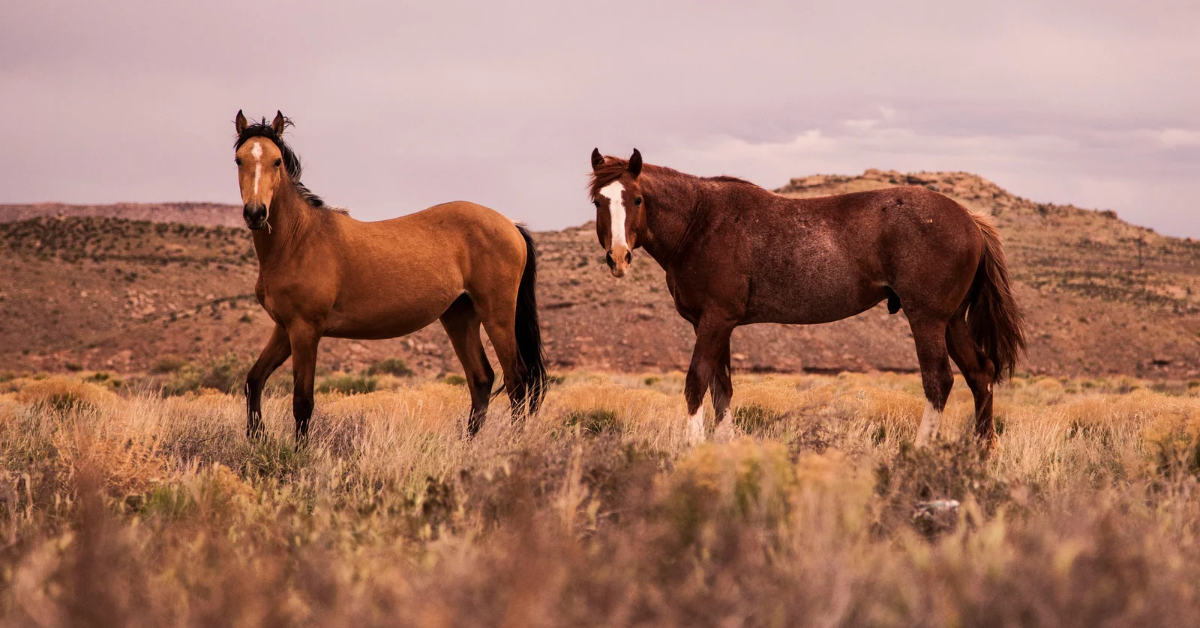
They are the iconic image of the American West—manes flying, hooves thundering across public lands. Behind that image sits a federal management system that breaks up wild family bands and, through a 2004 statutory loophole, allows federally protected horses to enter the slaughter pipeline. This guide explains how the system works, who built it, what is succeeding on the ground, and where you can direct your time or funding—with verifiable sources throughout.
Take Action in 5 Minutes
- Call your U.S. Representative and ask them to cosponsor H.R. 4356 (to phase out helicopter roundups). Find your member at house.gov.
- Donate $30 to AWHC’s PZP program—the cost of darting one mare and keeping her wild. americanwildhorse.org
- Share this post with one person who cares about animals.
Part 1: The Reality on the Range
Helicopter roundups
The Bureau of Land Management (BLM) uses low-flying helicopters to drive wild horses into traps. Chased across rough terrain at speed, horses can suffer exhaustion, injuries, and fatal accidents. H.R. 4356’s own findings state that “the use of helicopters to chase equines over prolonged distances, usually on rough terrain, is particularly dangerous, and can frighten the animals and lead to deadly situations, often miles from public view.”
- August 2026 Northwest Colorado roundup: During a multi-week gather in the Piceance-East Douglas Creek and West Douglas herd management areas, the BLM captured 894 wild horses and nine died or were euthanized. The agency attributed the deaths to pre-existing conditions and other causes; critics point to the stress of the chase.
- Political pushback: On September 3, 2026, Colorado Governor Jared Polis and Representative Joe Neguse formally called on the Interior Department to halt further helicopter roundups in the state, characterizing the practice as inhumane and unnecessary.
- Agency position: The BLM disputes that its gathers are inhumane and maintains that its handling methods follow animal welfare protocols. The “inhumane” characterization in this guide reflects the position of critics, including Polis and Neguse.
The slaughter pipeline and the Burns Amendment
The core statutory issue is a 2004 appropriations rider known as the Burns Amendment. It directs the BLM to sell “without limitation” wild horses and burros ages 10 and older, or younger animals that have not been adopted after three attempts—historically for as little as $25 or less. Once sold, the buyer immediately receives title and the animal loses federal protection as a wild horse.
The BLM acknowledges that it does not track animals after sale because they leave agency jurisdiction. Lawmakers, including Representative Dina Titus, have urged the agency to suspend the Sale Authority program, warning that it provides insufficient assurance against slaughter diversion.
A New York Times investigation published in August 2026 documented the scale of the pipeline:
- 3,718 wild horses were sold in 2025, more than double the roughly 1,500 sold in 2024.
- At least one buyer purchased horses at $25 per head and resold them to Canadian slaughterhouses, where horses can fetch up to $750 each.
- Recent policy shift: Following public and congressional scrutiny, the BLM raised its base sale fee from $25 to $125 and added language to the bill of sale barring buyers from “recklessly or negligently” selling an animal to slaughter. Advocates view these steps as incremental improvements rather than a permanent closure of the statutory loophole.
The land-use context
The BLM manages roughly 245 million surface acres of public land across the West. Livestock grazing is authorized on about 155 million acres, while wild horses and burros are restricted to about 26.9 million acres—roughly 11% of BLM land, most of which is shared with livestock.
Table: Land Allocation
| Land Allocation | Approximate Acreage | Share of BLM Land |
| Livestock grazing | ~155 million acres | ~63% |
| Wild horse and burro Herd Management Areas | 26.9 million acres (177 HMAs) | ~11% (mostly shared with livestock) |
Advocates argue that prioritizing commercial livestock forage over wild horse habitat drives artificial “overpopulation” claims. The BLM maintains that many Herd Management Areas exceed Appropriate Management Levels (AMLs), particularly during prolonged Western droughts.
Part 2: Who Built This System
- Senator Conrad Burns (R-Montana): Widely identified as the architect of the Sale Authority loophole. In 2004, as chair of the Interior Appropriations Subcommittee, he inserted the rider into the FY2005 omnibus spending bill, bypassing a standalone vote.
- The Bureau of Land Management (BLM): Implements the program. While official agency policy opposes selling horses for slaughter, the absence of post-sale tracking and years of low sale pricing created the opening exploited by kill buyers.
Current leadership (opinion: wild horse advocates hold these officials responsible for continuing the roundup and sales framework):
- Doug Burgum — Secretary of the Interior. Official profile: doi.gov/secretary-doug-burgum
- Stevan “Steve” Pearce — Director of the BLM, sworn in May 19, 2026 as the 20th Director. Official profile: edit.blm.gov/bio/steve-pearce
Part 3: What Is Being Done
Federal legislation
The SAFE Act (H.R. 1661 / S. 775) would permanently prohibit the slaughter of horses for human consumption in the United States and ban the transport of horses for slaughter. It holds 230 House cosponsors. On May 22, 2026, the House Transportation and Infrastructure Committee passed the bipartisan Van Drew–Titus Amendment to the BUILD America 250 Act by a 34–30 vote, incorporating SAFE Act language to prohibit transporting equines for slaughter. The amendment “achieves the same policy goal” as the SAFE Act and now awaits consideration on the House floor—it still requires passage by the full House and Senate.
Wild Horse and Burro Protection Act (H.R. 4356): Introduced by Representative Dina Titus (D-Nev.), this bill would phase out the use of helicopters and fixed-wing aircraft in wild horse management over two years. It currently has 22 cosponsors—20 Democrats and 2 Republicans—and awaits action in the House Natural Resources Committee.
Litigation
- Habitat protection (10th Circuit): Return to Freedom and co-plaintiffs won a ruling in the 10th U.S. Circuit Court of Appeals holding that the BLM violated federal law when it attempted to strip roughly 2 million acres of wild horse habitat in southwestern Wyoming’s Checkerboard region.
- Transparency via FOIA: FOIA-obtained records have compelled disclosure of gather records and sale logs that underpinned 2026 reporting on the slaughter pipeline; multiple organizations have pursued these documents.
- Pryor Mountain (Montana): The Cloud Foundation sought a temporary restraining order and preliminary injunction to halt the BLM’s gather of Pryor Mountain mustangs. On October 17, 2026, U.S. District Judge William Mercer denied the request, allowing the agency to proceed with a plan to remove 37 animals from a herd estimated at 185.
Fertility control: the proven alternative
American Wild Horse Conservation (AWHC) operates the world’s largest humane wild horse fertility control program on Nevada’s Virginia Range, managing roughly 3,500 horses across nearly 300,000 acres.
- How it works: Trained field darters administer the PZP immunocontraceptive vaccine remotely without rounding up or removing horses.
- Cost comparison: A single dose of PZP costs roughly $30. AWHC documents a lifetime management cost of about $1,350 per mare on the range, compared with roughly $48,000 to maintain a single captured horse in long-term BLM holding facilities.
- Results: The program has stabilized herd growth rates while keeping family bands intact and wild. Congress has earmarked funding for fertility control, and advocates continue pressing the BLM to shift funds from helicopter removals to on-range darting.
Sanctuaries and rescues
- Return to Freedom (RTF): Provides sanctuary for more than 450 rescued wild horses and burros across its California locations. Its Wild Horse Defense Fund drives federal lobbying, grassroots advocacy, and litigation. Volunteer contact: volunteers@returntofreedom.org
- Skydog Sanctuary (Oregon): Cares for 325 wild horses and over 60 burros on its 9,000-acre ranch near Bend, Oregon, specializing in horses pulled from kill pens and auctions.
- Salt River Wild Horse Management Group (SRWHMG): Manages Arizona’s Salt River herd through humane PZP fertility control, feed supplementation, and monitoring—funded almost entirely by public donations and reporting no state funding for its core program. As of April 2026, it had raised $7,500 of a $30,000 legal fund target.
State-level wins
Salt River, Arizona: On August 31, 2026, Governor Katie Hobbs announced a $325,000 grant to fund a comprehensive genetic viability study of the Salt River Horse Herd. The Arizona Department of Agriculture paused herd removals for 2026 and 2027 while the research is underway. The herd is estimated at 274 horses.
Part 4: Your Action Toolkit
Where a dollar goes furthest
- Change federal law and policy: Return to Freedom’s Wild Horse Defense Fund — returntofreedom.org
- Scale humane fertility control: AWHC’s PZP Program ($30 covers one vaccine dose) — americanwildhorse.org
- Support rescued horses directly: Skydog Sanctuary (hay and veterinary care) — skydogranch.org/donate
- Defend state-level herd protections: Salt River Wild Horse Management Group — saltriverwildhorsemanagementgroup.org
Use your voice
- Contact your U.S. Representative and Senators: Ask them to cosponsor H.R. 4356 (to end helicopter roundups) and pass the SAFE Act (H.R. 1661 / S. 775). Include your name, city, and ZIP code so your message is logged as a constituent contact.
- Submit public comments: Before every BLM roundup or Herd Management Area plan revision, the agency opens a public comment window. Wild Horse Education publishes active deadlines and comment guides at wildhorseeducation.org.
- Amplify active campaigns: Sustained public pressure directly influenced the Salt River removal pause in Arizona and heightened congressional scrutiny of the BLM sales program.
Volunteer and adopt
- Volunteer on the ground: Return to Freedom welcomes sanctuary volunteers (volunteers@returntofreedom.org), and SRWHMG relies on local volunteers for daily herd monitoring and habitat stewardship in Arizona.
- Adopt a mustang: The BLM’s standard adoption fee is a $125 base fee for an untrained wild horse or burro. Several regional nonprofits also offer trainer-incentive and placement sponsorships to help first-time adopters succeed.
Know your First Amendment rights
Publicly criticizing federal agencies and government officials is core protected speech under the First Amendment. Under the Supreme Court’s “actual malice” standard (New York Times v. Sullivan), public officials face a high legal threshold to bring a defamation claim. To keep your advocacy legally watertight: rely on verifiable public records, clearly label opinions as opinions, and avoid making unverified factual accusations against individuals. (General information only, not legal advice.)
Glossary
- AML (Appropriate Management Level): The population target the BLM sets for a Herd Management Area.
- HMA (Herd Management Area): Designated public land where wild horses and burros are managed.
- PZP (Porcine Zona Pellucida): A reversible immunocontraceptive vaccine delivered by remote dart; it prevents pregnancy without removing a mare from the range.
- Sale Authority: The program created by the Burns Amendment allowing the BLM to sell certain wild horses “without limitation,” after which they lose federal protection.
- Capture myopathy: A potentially fatal muscle condition caused by extreme exertion and stress during capture.
Sources and Verification
- H.R. 4356 (Wild Horse and Burro Protection Act): Congress.gov — H.R. 4356; GovTrack cosponsor list
- SAFE Act and Van Drew–Titus Amendment: Return to Freedom, May 22, 2026; Congress.gov — H.R. 1661
- BLM sales policy change: Return to Freedom, August 6, 2026
- 2025 sales figures and slaughter pipeline: New York Times investigation, as syndicated in the Virgin Islands Daily News, August 21, 2026
- Burns Amendment: Senate Appropriations hearing record, FY2010, describing the 2004 rider
- Colorado roundup: Colorado Sun, September 3, 2026; AWHC roundup report, September 2, 2026
- Land allocation: AWHC, “Livestock vs. Wild Horses” (BLM data: 245 million acres managed; 155 million grazed; 26.9 million for wild horses)
- PZP costs: Lucky Three Ranch / AWHC ($30 per dose; $1,350 lifetime per mare vs. $48,000 in holding)
- Pryor Mountain ruling: Billings Gazette, October 21, 2026
- Skydog Sanctuary: skydogranch.org/about (9,000 acres; 325 wild horses; 60+ burros)
- Return to Freedom: RTF 2026 program materials (more than 450 wild horses and burros)
- Salt River pause and genetic study: Office of Arizona Governor Katie Hobbs, August 31, 2026 ($325,000 grant; pause through 2027; 274 horses)
- SRWHMG legal fund: SRWHMG, April 26, 2026 ($7,500 raised of $30,000)
- BLM adoption fee: 43 CFR 4750.4-2 ($125 base fee)
- BLM Director: BLM biography (sworn in May 19, 2026)
The Bottom Line
The wild mustang crisis stems from a 2004 appropriations rider, an untracked sales system, a land-use framework that confines wild herds to roughly 11% of BLM acreage, and delayed congressional action on a permanent slaughter ban. At the same time, measurable solutions are already working: bipartisan anti-slaughter language has cleared a key House committee, on-range PZP fertility control has proven dramatically cheaper than holding, federal courts have blocked unlawful habitat removals, and state-level pressure has halted removals in Arizona. Closing the gap between proven solutions and federal policy comes down to sustained public pressure—and to people like you who are willing to make a call, send a donation, or share the truth about what is happening. The wild horses cannot speak for themselves. But you can.